What Did I Do Right?!

In one of my earliest horsemanship lessons, at the beginning of my Fell Pony career, I asked my instructor a question.  It was when my pony did something other than what I was trying to get it to do, and I asked, “What did I do wrong?”  Bless Ezra Marrow for his answer!  He said it’s just as important, if not more so, to ask what we’re doing right as it is to ask what we’ve done wrong.  We need to take credit when things go well, especially if we’re going to beat ourselves up when they go otherwise.

200208 Rose ears cattle.jpg

So when I had rides on my Fell Pony mare Willowtrail Wild Rose two days in a row where she was nearly perfect, I asked myself “what did I do right?!“  After days and days of rides with refusals and reverses and broken gaits, how had I come to those rides on those days differently?  Of course, there are numerous other factors over which I have little control, such as the weather, the state of mind of the cattle near which we ride, not to mention the state of mind of my pony!  And now with breeding season approaching, it could also be changes I’ve made to her diet in advance of boy-meets-girl.

One of the first horsemanship books I was given as a gift was Centered Riding by Sally Swift.  What I took away from Swift’s emphasis on soft eyes was remembering to take in the set of the ears of one’s mount, not just where we want to go and the path we want to take to get there.  I am very tuned in to not only where Rose’s ears are pointing when we ride but where the tip of her nose is, too.  When she starts to turn it away from our line of travel, I’ve found that returning it to our line of travel seems to help to keep Rose focused on the ride we’re taking versus letting her attention drift to the many, many things in our surroundings that she could decide to be worried about, from calves and bulls to tractors to turkeys to deer.  Other ponies I’ve ridden haven’t required that sort of assistance with focus.

I once took Rose’s half-sister Lily to a horsemanship clinic to see what guidance the instructor could give me on improving our relationship doing groundwork.  He said I needed to be more provocative with her, that she wasn’t sufficiently engaged with me in our current manner of work.  By ‘more provocative’ he meant to do quick changes of direction and cues to get her really paying attention.  I found this very challenging.  I tend to be the slow-twitch rather than the fast-twitch sort of person - think long distance running rather than sprinting - and he was suggesting I needed to be different than I am.  What I’ve learned with Rose is that instead of speed I can ask for more precision, and this keeps her engaged.  If I ask for a step back, I want it now, not a few seconds after she thinks about it.  If I ask for her feet to move in a particular direction, I return her to the starting point and try again until we get exactly what I want.  If I want her to stand still, she doesn’t get to move her feet, at all.  We will return to the original placement of all feet and stand still again until I ask for something different.  Mind, Rose is fully mature, so I’m working with a mature brain; I wouldn’t expect this sort of precision from a less-trained or less-mature pony unless they were ready for it.  I think this sort of precision work is part of what I’ve done right with Rose. Other ponies I’ve worked with have been willing to give me their cooperation without asking for this sort of precision work first.

Treats as training aids are as controversial as any topic in horsemanship.  I know people who don’t ever use them, and I know more people who don’t use them as well as they could.  I remember a master horseman once saying that if you are adamantly against ever using treats then you have removed a tool from your toolbox.  Rose is motivated by treats, and I use them at particular times to reward particular behavior and attention. I have found they can make a positive difference with Rose.  And I am always experimenting with how she responds with and without them.

Everyday Rose comes up with ways to test if I’m paying attention, so I always need to be very alert to any new behavior she’s bringing to our time together.  When we have times that we are in harmony, though, it is magical, and I am more motivated than ever to figure out what I did right!

© Jenifer Morrissey, 2020

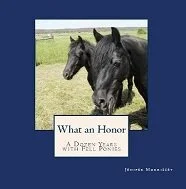
My book The Partnered Pony contains many practical stories like this one. It is available internationally by clicking here or on the book cover.

Acknowledging Rose and Her Pre-Flight Checks

One of my earliest memories of my first Fell Pony Sleddale Rose Beauty makes me chuckle now, though at the time it was definitely Beauty who was doing the chuckling.  I had gone out to handle her feet, and I was using the technique that was working on my other (non-Fell) ponies.  Beauty, though, had absolutely no interest in cooperating with my approach, though I knew she knew what I wanted.  I could pull her feet off the ground by pulling on her feather, but I couldn’t get her to lift them for me.  Eventually, Beauty was one of my favorite hoof trimming objects because she was so cooperative, but that first time, I was the one getting the lesson about how things should go.

“What’s next?!!”

“What’s next?!!”

As I have been bringing my mare Willowtrail Wild Rose back into work, I have often thought back to other ponies in her line that I have worked with in the past.  In addition to her mother Beauty, I worked with her half-sister Lily.  When I went back and re-read things I wrote about working with Beauty and Lily, I chuckled with recognition.  Rose is definitely of that line!

In the last few days, Rose’s attitude towards me has definitely changed to one of intense interest in what we might do together.  The photo here shows her in that frame of mind.  What got us to this rewarding point was acknowledging Rose like I used to acknowledge her mother and doing pre-flight checks like I used to do with her sister.  To read about acknowledging Beauty, click here.  To read about Lily’s pre-flight checks, click here.

After I met my friend and mentor Joe Langcake, I asked him about Beauty’s type of cooperation.  He replied that he had owned a Sleddale mare once, and he had got shot of her because she was too much work; she took too much effort to bring along.  Christine Robinson of the Kerbeck Stud acknowledges that ‘they are certainly independent,’ but they have a type of physical package – legs and feet, bone and substance, broad back and wide chest – that make them worth the effort.  Christine has said, ‘I found all our [Sleddale] ponies were really willing to please and good workers.” (1) Joe acknowledged that when he later saw his former Sleddale pony at a show, he was very impressed with her.

When Rose was born, I thought that now I might have a pony in that line that I could work with.  I so loved Beauty’s type that it is a conservation goal of mine to keep it going since the Sleddale ponies are no longer being bred.  Rose is definitely of that line, but she also is willing to be a good worker, as long as I acknowledge her and pass her pre-flight checks!

  1. Morrissey, Jenifer.  “The Sleddale Fell Ponies and Mr. Henry Harrison,” Fell Pony Express Volume 11 Number 2, Fall/Winter 2012, Fell Pony Society of North America, p. 10.

© Jenifer Morrissey, 2020

There are lots of stories about Rose’s relations in my book What an Honor, available internationally by clicking here or on the book cover.

Bringing Rose Back Into Work

To say I’ve been surprised by how difficult it has been to bring my Fell Pony mare Willowtrail Wild Rose back into work would be an understatement.  Previously she had taken me on lovely trail rides, packed loads in panniers, worked in harness moving manure, and begun to pull a cart.  Then I gave her a few years off to be a broodmare.  I began to bring her back into work slowly, I thought, by taking a short ride and then each day adding a little more distance.  All went well for a few days.  Then one day she absolutely refused to let me ride her down the road, one that she had happily taken me down a few days before.  I was both frustrated and confused.  And these feelings of frustration and confusion continued when day after day, my various strategies that previously had been successful couldn’t convince her to go down that road again.

200128 Rose ears trail.jpg

To her credit, she didn’t buck, rear, or bolt.  Her favored expression was reverse gear which she could do remarkably ably, quickly, and on cue – whenever I asked her to go forward!  Rarely would she let me make up lost ground.  I set up the round pen to see if there was something broken in our basic relationship.  Nothing there.  I tried hand-walking her over the offending ground.  I tried backing her up the road on-line.  I tried circling her on-line, moving up the road with each revolution.  She made it clear she wasn’t afraid, she was just determined not to go under saddle.  That’s when I contacted my friend Eddie.

Eddie has a Fell Pony mare who will do anything for him; she is as sassy as they come but Eddie is her match.  Recently, at their combined age of 97, he brought her out of retirement to harrow the arena at the barn where she is stabled.  Eddie often tells me stories about other people at the stable asking for his assistance when they are having trouble with their mounts.  One story stuck in my head, and when I told Eddie about my problems with Rose, he agreed it was the right teaching story to recount.  A big warmblood was suddenly refusing to go through a gate out of the yard that previously he had been more than willing to pass through.  His rider had tried all manner of strategies, all without success.  The gelding wasn’t scared; he’d just decided that his idea about the gate was better than his human’s.  Eddie worked with the young woman on a plan, advising her to be prepared because the horse might buck, rear, or bolt.  The plan was for Eddie to be stationed just before the gate with a long-handled heavy plastic scoop shovel in hand.  As the warmblood and his mount came to the gate, the big boy as usual refused, and Eddie swatted him on the rear with the shovel.  Through the gate horse and rider quickly went!  The next day Eddie was again stationed in the same spot, and when the horse saw him, it was clear that he pondered refusing but thought better of it and went through the gate.  The horse is back to compliantly going through the gate without Eddie’s motivating presence.  He just needed convincing that perhaps his idea about the gate wasn’t the right one after all.

Eddie lives thousands of miles from me, so I had to figure out how to set up a similar lesson for Rose that I could execute alone.  I did figure it out, and I was absolutely amazed how this one simple thing changed our relationship.

In the final chapter of the book Kinship with All Life, a friend of the author’s wants to experience the same degree of connection with one of the author’s animal friends as the author has.  It doesn’t go well at first. The visitor has all kinds of preconceived notions about how things should go between a human and the animal’s kind, and the animal knows this instantly and chooses not to interact with the visitor.  Then, after much coaching from the author, the visitor changes his mental approach and comes to the animal in this new frame of mind.  Instantly it is clear to all present that the visitor has succeeded in achieving his goal of connection.

My work with Rose continues to progress.  Every day I find new ways to come to our work that acknowledges her role in our relationship and mine.  She’s made it clear it’s not about leader and follower.  She just needs me to be the best version of myself I can be.  Challenging, yes, but hard to argue with!

© Jenifer Morrissey, 2020

More stories about partnering with my Fell Ponies can be found in my book What an Honor, available internationally by clicking here or on the book cover.